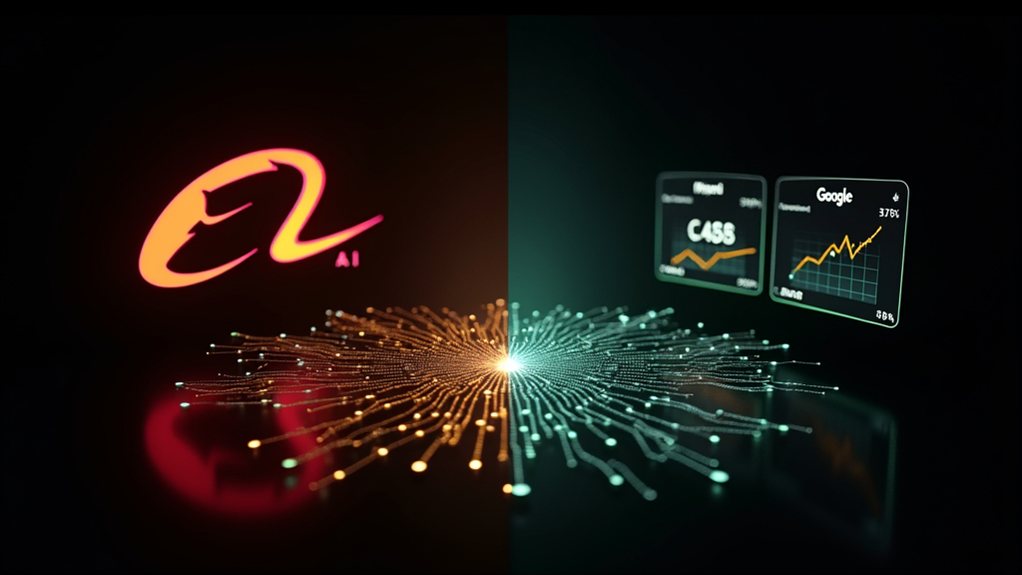

In the bustling arena of artificial intelligence, Alibaba’s Qwen AI is stepping up to the plate and swinging for the fences. It’s not just playing catch-up; it’s hitting home runs. With Qwen 2.5-Max outperforming heavyweights like DeepSeek V3, Meta Llama 3.1, and OpenAI’s GPT-4o across major benchmarks, it’s clear Alibaba means business.
Alibaba’s Qwen AI is not just competing; it’s dominating, outshining industry giants like GPT-4o and DeepSeek V3.
Need more proof? The QwQ-32B model takes the cake, outperforming DeepSeek R1 with a mere 1/20th of the parameters. Talk about efficiency.
Qwen 2.5 isn’t just a pretty face. Trained on a staggering 20 trillion tokens and fine-tuned with over half a million human feedback annotations, it’s like it went to the AI equivalent of Harvard. The efficient MoE design helps it shine, making it competitive across various tasks. Grok-3’s extensive training data is a testament to the importance of large datasets in achieving high performance.
And hey, it doesn’t just do well in theory; it’s acing AIME, MATH, and scientific reasoning tasks, leaving OpenAI’s o1 scratching its head.
Open-source adoption? Yeah, Qwen’s got that covered too. By the end of January, over 90,000 derivative models had popped up globally, all thanks to its accessible APIs via Alibaba Cloud Bailian. That’s a lot of developers jumping on the Qwen bandwagon.
While Microsoft Phi boasts 20 million downloads, three times that of Qwen, it’s not like Qwen is exactly slacking off in the popularity department.
Multimodal capabilities? Check. Qwen 2.5 handles multilingual and vision-language tasks like a pro. It’s got a strong focus on e-commerce, making it perfect for creating product descriptions that don’t put you to sleep.
Plus, it even takes control of PCs—setting a new standard that makes you wonder what else it can do.
When it comes to ecosystem integration, Alibaba is on fire. With APIs accessed by 290,000 entities, they are expanding EBITA margins through higher-margin AI products. Alibaba is also planning to invest over 380 billion yuan in AI infrastructure over the next three years to further enhance its competitive edge.
Sure, Microsoft Azure AI is raking in over $13 billion, but Qwen is carving out its niche with creative efficiency. It’s not all roses, though. Qwen’s initial safety issues and prompt injection vulnerabilities are a wake-up call.
But hey, it’s a work in progress, and it’s making strides.