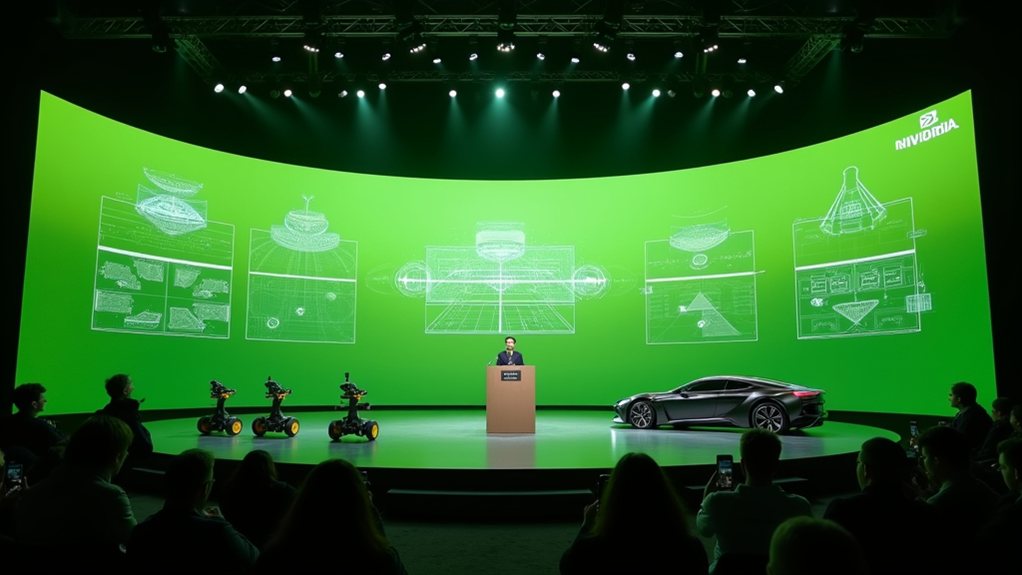
Jensen Huang kicked off CES 2026 with a bang at the Fontainebleau in Las Vegas, and boy, did he have some bold claims to make. He declared that AI is scaling into every domain and device. Not just a buzzword, folks—this is the future he’s selling. Huang emphasized how computing has been reshaped by accelerated computing and AI, and he’s not just talking numbers. He pointed to a staggering $10 trillion modernization in computing over the last decade. That’s a lot of zeros.
But wait, there’s more. Enter the Rubin platform, the first extreme-codesigned six-chip AI architecture. Say goodbye to the old Blackwell, because the Rubin is ready to take over in the second half of 2026. Huang claimed it slashes token generation costs to a mere tenth of what they once were. It’s about speed and storage upgrades, too. Who doesn’t want that? The platform also boasts AI-native storage with the Inference Context Memory Storage Platform, significantly enhancing overall performance.
Enter the groundbreaking Rubin platform, boasting a six-chip AI architecture that drastically cuts token generation costs and enhances speed and storage.
Then he rolled out the Alpamayo models, a family of open reasoning models targeted at autonomous vehicle development. This isn’t just tech talk; it’s part of a larger push to integrate AI into every corner of our lives. These models will help self-driving cars make sense of the world, tying seamlessly into the DRIVE Hyperion platform. It’s modular, level-4-ready, and already making waves with automakers and robotaxi providers. Huang’s vision? Every car and truck could be autonomous. Buckle up, everyone.
On the stage, physical AI and robots made a splash, too. Huang touted a full-stack approach that fuels a global physical AI ecosystem. With partners like Boston Dynamics and Franka, they’re not just talking about robotics; they’re demonstrating it. Tiny, beeping, hopping robots stole the show, proving that manufacturing plants could very well become giant robots.
NVIDIA also expanded its partnership with Siemens. Together, they’re building an industrial AI operating system that integrates NVIDIA’s full stack with Siemens’ industrial software. This is where innovation meets production. CES 2026 highlighted the importance of AI in driving technological advancements across multiple industries.
Let’s not forget gaming. Huang teased the future of neural rendering, ahead of DLSS advancements. With new features like DLSS 4.5 and MFG 6X, they’re pushing the envelope. The RTX 5090 could be the pinnacle of traditional rasterization. AI for in-game characters is on the horizon, pushing emotional realism to new heights.
NVIDIA’s rivals? They’re scrambling. Jensen Huang has made it clear: the future is here, and it’s powered by AI.