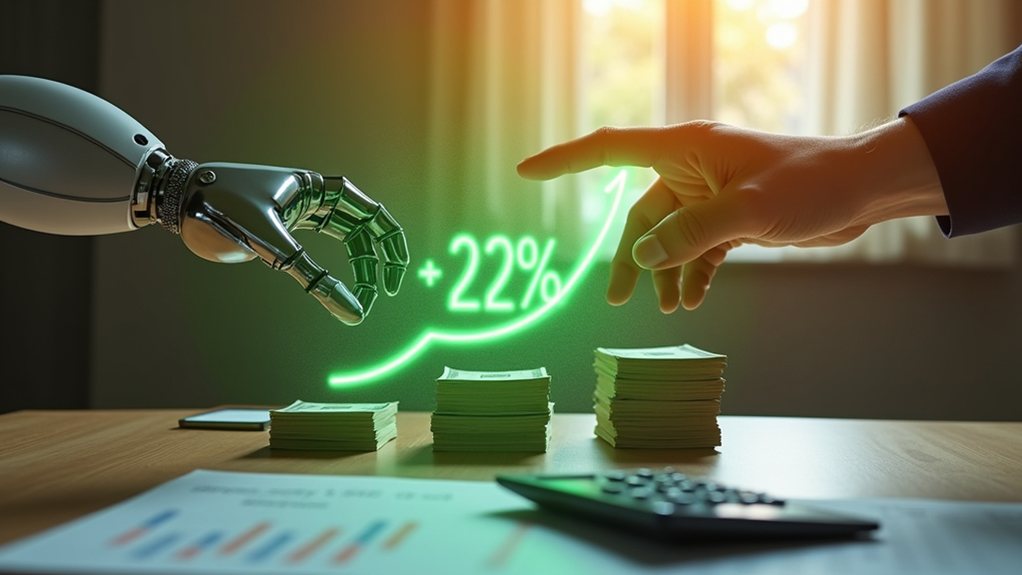

In a world where robots are often seen as the villains threatening to take everyone’s jobs, a surprising twist is emerging: AI might actually boost wages for low-skill workers. Yes, you read that right. According to new findings, AI could raise average wages by a whopping 21 percent while also curbing wage inequality. It’s like a fairy tale, but instead of a magic wand, it’s all about algorithms and machine learning.
AI could be the unexpected hero, boosting low-skill wages by 21% and reducing wage inequality through smart algorithms.
How does this happen? A simplification channel, apparently. It makes lower-skill workers more productive in tasks typically reserved for higher-skill employees. Think about that for a second. The tech that many fear will replace jobs is actually making workers better at what they do.
Those entering the labor market could see welfare gains equivalent to permanent wage increases of 26-34%. That’s a pretty sweet deal for those trying to make ends meet. Moreover, this trend shows that AI reduces wage inequality while simultaneously enhancing opportunities for workers across the board. Despite these promising statistics, there’s still a lot of anxiety among workers. A survey found that 52% of individuals earning under $50,000 are worried about AI’s impact on their jobs. Almost half of them, 48%, see potential opportunities, but there’s a looming fear of displacement. A staggering 70% want to hit the brakes on AI development if it means job losses. Talk about mixed feelings!
Training is another sticky point. Eighty-six percent of low-wage workers say they would jump at free AI training opportunities. But let’s be real: housing costs and inflation are major roadblocks. While many want government-led job training initiatives, it’s unclear how quickly action will be taken. Furthermore, 67% support government-led job training initiatives to help workers prepare for an AI-driven economy. Still, those who believe in hard work leading to a better life are feeling more confident about adapting to an AI-driven economy.
Meanwhile, younger workers are feeling the pinch. Employment for 22- to 25-year-olds in high AI exposure jobs took a hit, dropping 6% from late 2022 to mid-2025. On the flip side, the 30-and-over crowd is seeing job growth.
What’s happening? Well, it seems like lower-skill tasks are the most vulnerable to automation.
Then there’s the occupational shift. Goodbye administrative jobs; hello science occupations! But it’s not all sunshine and rainbows. While some fields expand, others face declines. AI is reshaping the labor market, and it’s doing it with a ruthless efficiency.