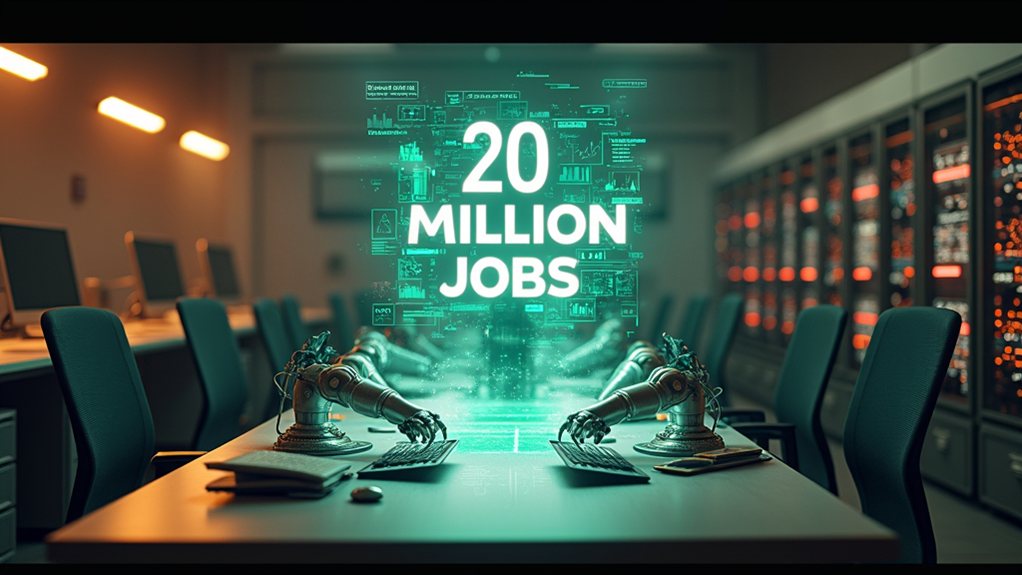

In a world where robots are getting smarter, it turns out AI is already handling the jobs of about 20 million Americans. That’s right—20 million. A recent MIT study, using the Frontier supercomputer through Project Iceberg, reveals that AI can perform tasks equivalent to 11.7% of the U.S. labor market. That’s a staggering 151 million workers and a jaw-dropping $1.2 trillion in wages at stake. Talk about a game changer.
The study covers 923 job types across nearly 3,000 counties. It’s an in-depth exploration into how AI is not just a fancy tool, but a serious competitor. The Iceberg Index highlights which jobs are at risk. Spoiler alert: it’s mainly high-paying roles in tech, finance, healthcare, and professional services. So, if you thought your job was safe, think again. AI is churning out over a billion lines of code daily and can process documents faster than any human. Goodbye, tedious paperwork!
AI is reshaping the job landscape, targeting high-paying roles in tech, finance, healthcare, and professional services.
Here’s the kicker—this isn’t about mass layoffs or robots taking over the world tomorrow. The study doesn’t predict widespread job losses. Instead, it reshapes existing roles. Entry-level positions, like coding jobs held by fresh graduates, are at risk. But don’t worry; AI isn’t about to wipe out the entire workforce. It’s more about freeing up humans for higher-value tasks. Nurses can spend more time with patients instead of drowning in paperwork. Who wouldn’t want that? AI can perform work equivalent to nearly 12% of America’s workforce.
But let’s not get too optimistic. The study shows that while AI is cost-competitive for about 12% of the workforce, the actual adoption depends on business strategies and societal acceptance. Just because it’s possible doesn’t mean it’s practical. The gap between potential and real-world application is huge. AI’s impact on the workforce indicates that the urgency for companies to adapt is increasing rapidly.
Historically, from 2010 to 2023, AI hasn’t led to catastrophic job losses. Instead, firms adopting AI have seen employment growth of 6% and sales growth of 9.5%. So yes, AI is a disruptor, but it’s also a catalyst for faster growth.
The future is murky. Generative AI could expand what tasks AI can handle. Will that mean more disruption? Probably. But for now, the thrill of AI performing jobs once held by millions isn’t about doom and gloom. It’s about charting a brave new world where humans and machines work side by side—or at least, that’s the hope.