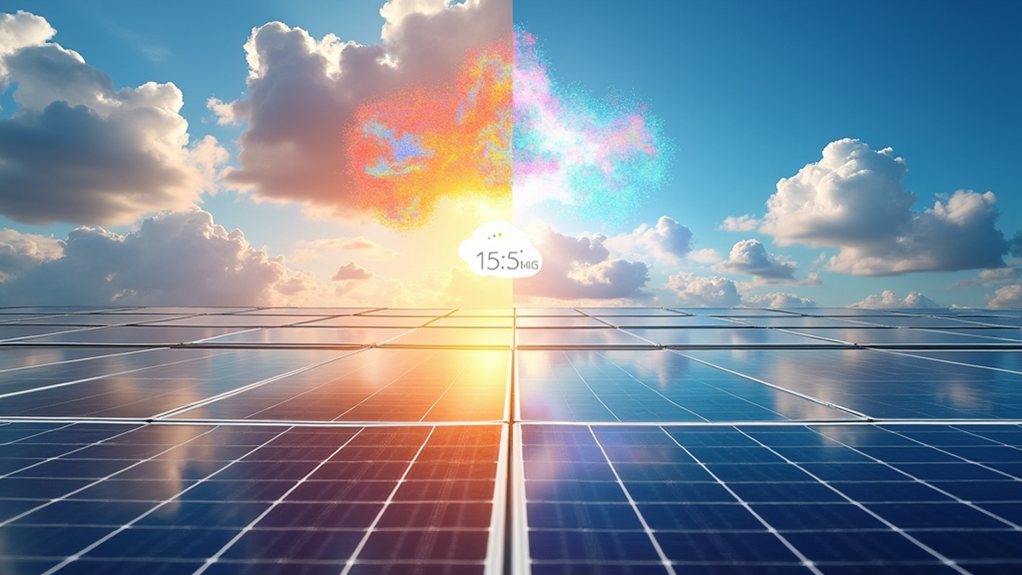
In a world where sunshine is supposed to be a sure thing, predicting clouds can feel like trying to catch smoke with your bare hands. Just think about it. You plan a picnic, and suddenly, those fluffy white clouds turn into a torrential downpour. Enter AI cloud forecasting, a game-changer in the solar power sector. Researchers at the Fraunhofer Institute for Solar Energy Systems ISE have developed methods that use machine learning to analyze past satellite images and predict cloud development in as little as 15 minutes to four hours. Talk about a quick turnaround!
AI cloud forecasting is revolutionizing solar power by predicting cloud development in just 15 minutes to four hours.
But wait, it gets better. Those pesky early mornings? The ones where sunlight is just a distant dream, and satellite images look like a blurry mess? Traditional imaging systems can’t handle that. They throw up their hands and say, “Nope.” But with the integration of infrared technology, the forecasting game changes completely. Infrared channels can operate independently of sunlight, meaning predictions can roll in around the clock. Goodbye, morning guessing games. Hello, reliable forecasts!
The significance of accurate solar radiation forecasts cannot be overstated. Grid operators and solar power suppliers depend on these predictions to effectively distribute electricity. With fluctuating renewable energies becoming the norm, accurate forecasting is no longer a luxury; it’s a necessity. Every minute counts in the operational decision-making process, and short-term radiation predictions can make or break a utility’s strategy. No pressure, right? Additionally, as AI’s role in shaping energy demand evolves, it will further enhance the precision and reliability of these forecasts.
Here’s where the numbers get juicy. That AI-supported forecasting? It reduced error margins by an impressive 11 percent compared to traditional models. That’s not just a fancy statistic; it means real improvements in grid reliability and renewable energy integration. Fewer errors lead to better resource allocation. Operators can breathe a bit easier knowing they have a more accurate picture of what the clouds are up to.
Of course, the renewable energy sector is on a roll. Currently, renewables supply around 27 percent of electricity consumed by data centers globally. As this number climbs—projected to grow by 22 percent annually—accurate forecasting will be vital to keep up with demand and guarantee a smooth ride on the energy highway.