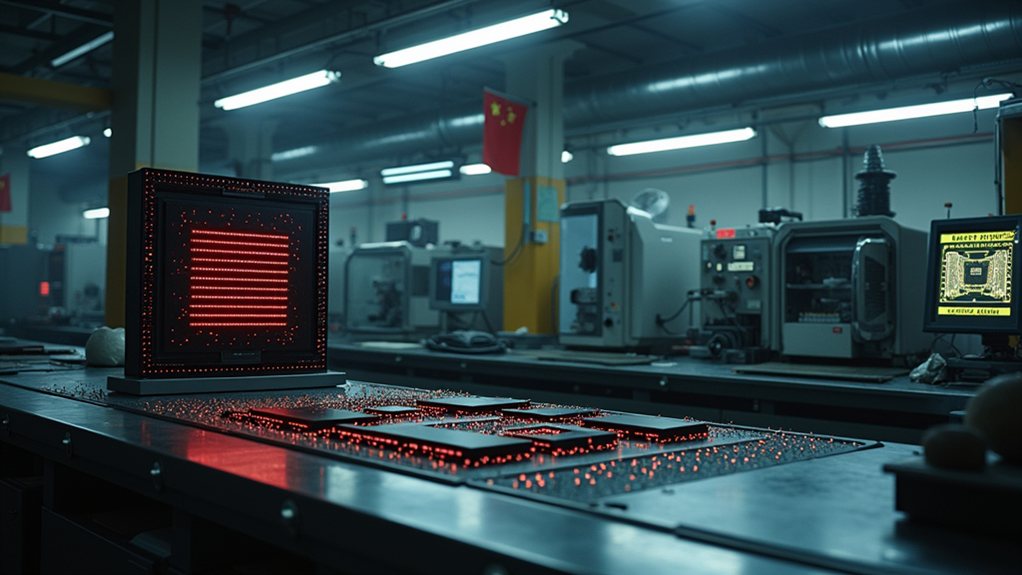

As China pushes hard into the world of artificial intelligence, it finds itself hitting some serious roadblocks. The ambitious country is stumbling in the face of chip bottlenecks. It’s like trying to run a marathon with two left feet. While the U.S. is cruising ahead with advanced semiconductors, China is stuck in a slow lane, unable to keep up. They can’t even produce chips at scale, which is a central issue that’s slowing everything down.
Those fancy lithography machines? Yeah, they’re a key production capacity problem. And let’s not forget about the software ecosystem that limits domestic chip manufacturing. It’s a train wreck waiting to happen.
Lithography machines are a major bottleneck, and the software ecosystem is a ticking time bomb for China’s chip manufacturing.
Performance gaps are glaring. The U.S. is still the top dog in model capabilities, science, and complex reasoning. Meanwhile, Chinese open-source models are lagging behind. By a lot. According to some top Chinese leaders, the gap is only widening, with less than a 20% chance that Chinese firms will lead the pack in the next three to five years.
Sure, local companies might excel in efficiency, but they’re not exactly breaking new ground with regards to paradigm innovation.
In a bid to catch up, China is ramping up its open-source strategy. By 2026, they’re doubling down on the idea to influence the global AI infrastructure. Alibaba Cloud is emerging as a go-to for both local and overseas users. That’s right, they’re foregoing Western know-how and banking on homegrown tech like Alibaba and Huawei. Bold move!
Yet, government initiatives are trying to boost this high-quality AI development. They’re promoting R&D in datasets, large models, and applications. It’s a four-level system they’re cultivating, hoping to support innovative platforms. Sounds good on paper, but will it work? The US Pushes AI Tech Exports to Counter China is just one of the many challenges China faces in its ambitions.
The future challenges loom large. China needs breakthroughs in lithography for serious compute resolution. They need to develop a mature market for international competition. Risk-taking and paradigm-breaking entrepreneurs are essential, but those are in short supply. Additionally, the US leads in model capabilities and is maintaining a significant advantage in scientific applications.
Meanwhile, the next AGI paradigm, like autonomous learning, isn’t being led by China.
In the end, the race with the U.S. is complex and hard to forecast. OpenAI has even warned about potential seismic shocks from China. But with all these challenges, one has to wonder: can China really compete in the AI arena? It’s a tough pill to swallow.